
Quick answer
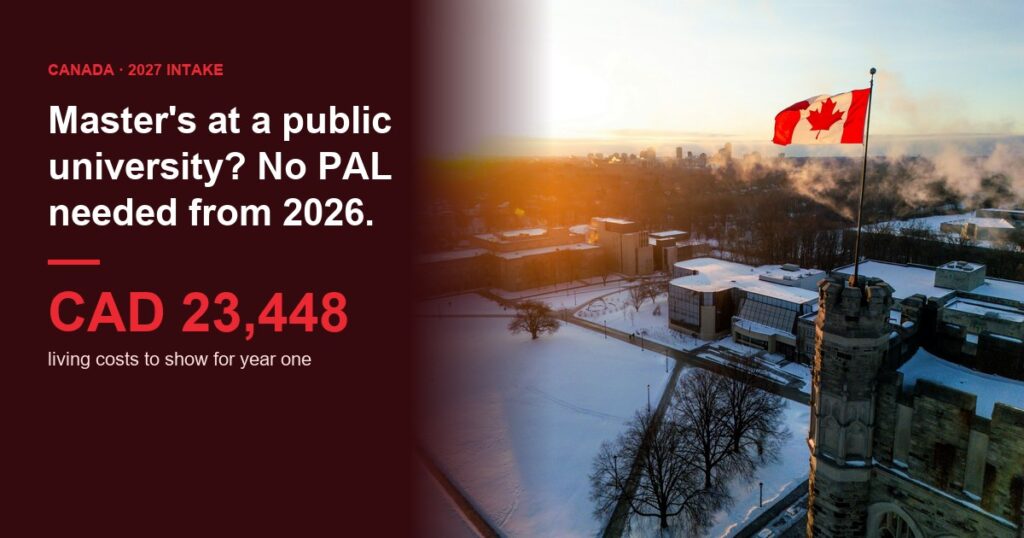
- Master’s and PhD students at a public Canadian university no longer need a provincial attestation letter (PAL) for study permits from 1 January 2026. Bachelor’s, diploma and college students still do.
- For living costs you must show CAD 23,448 (about BDT 20.7 lakh) for the first year if you apply on or after 1 September 2026, plus your first-year tuition and travel.
- The study permit costs CAD 150 and biometrics CAD 85.
- You can work 24 hours a week during term and full time in scheduled breaks. After a Master’s of 8 months or more you can get a post-graduation work permit of up to 3 years if you meet the CLB 7 English requirement.
Canada is one of the most searched study destinations in Bangladesh, and also one of the most confusing: PAL, GIC, proof of funds, caps and new work rules all changed in the last two years. This guide puts the 2027 rules in one place, with the costs in taka and the steps in the right order, so you know what to prepare before you apply.
Intakes and a realistic timeline
Canadian universities and colleges take students in September (the main intake, with the most programmes and scholarships), January and, for some programmes, May. Start at least 9 to 12 months before your intake.
| When | For September 2027 | What to do |
|---|---|---|
| 9-12 months before | September to December 2026 | Shortlist programmes, sit IELTS / PTE, prepare transcripts and recommendation letters |
| 7-9 months before | December 2026 to February 2027 | Apply to universities or colleges; many deadlines fall between December and March |
| 5-6 months before | March to April 2027 | Accept your offer, pay the deposit, ask the school for your PAL if you need one |
| 4-5 months before | April to May 2027 | Apply for the study permit online, then give biometrics in Dhaka |
| 1-2 months before | July to August 2027 | Book your flight and accommodation, plan your arrival |
Do you need a PAL?
The provincial or territorial attestation letter (PAL / TAL) confirms that the province has a study permit space for you under Canada’s study permit cap. Your school (the designated learning institution, DLI) arranges it; you do not apply to the province yourself.
| Your programme | PAL needed? |
|---|---|
| Master’s or PhD (degree-granting) at a public DLI | No, from 1 January 2026 |
| Bachelor’s degree | Yes |
| College diploma, certificate or postgraduate certificate | Yes |
| Programmes at a school in Quebec | A Quebec Acceptance Certificate (CAQ) instead |
A PAL is valid only for the cap year in which it was issued and must be valid on the day you apply for your study permit. If your study permit is refused, you need a new PAL to apply again, so it pays to get the first application right.
What studying in Canada costs, in taka
| Cost (first year) | CAD | About BDT |
|---|---|---|
| Tuition, Master’s (national average for international students, 2026-27) | 24,693 | 21.8 lakh |
| Tuition, Bachelor’s (national average for international students, 2026-27) | 42,062 | 37.1 lakh |
| Living costs you must show (one student, outside Quebec) | 23,448 | 20.7 lakh |
| Study permit + biometrics | 235 | 20,700 |
BDT amounts use CAD 1 = BDT 88.19 (mid-market rate, 12 November 2026). Tuition averages are from Statistics Canada; your own fee depends on the school and the programme.
Where you study changes the bill a lot. Average international tuition for 2026-27 ranges from about CAD 7,000 for graduate programmes in Newfoundland and Labrador to about CAD 28,900 for graduate and CAD 50,100 for undergraduate programmes in Ontario. Manitoba (about CAD 14,000 for graduate programmes) and the Atlantic provinces are often much cheaper than Toronto or Vancouver, and living costs are lower there too.
How much money to show for the study permit
IRCC wants to see that you can pay, without working in Canada, for your first-year tuition, living costs and travel, and for longer programmes, how you will pay for the rest.
| Applying on or after 1 September 2026 | Living costs (CAD per year) | About BDT |
|---|---|---|
| Student alone | 23,448 | 20.7 lakh |
| Student + spouse | 29,192 | 25.7 lakh |
| Student + spouse + 1 child | 35,888 | 31.6 lakh |
So a student going alone for a Master’s at an average-priced school needs to show roughly CAD 48,000 (about BDT 42.5 lakh) plus the flight; for a Bachelor’s it is about CAD 65,500 (about BDT 57.8 lakh) plus the flight. Paying part of your tuition in advance reduces what you have to show in the bank.
Which documents count
- Bank statements for the past 6 months (yours or your sponsor’s), showing where the money came from
- A GIC (Guaranteed Investment Certificate) from a Canadian bank: optional, but a clear way to show living costs
- A receipt for tuition already paid to the school
- An education loan sanction letter or a scholarship letter
- For a parent or relative sponsoring you: a letter stating the relationship and amount, plus their income proof (salary slips, business registration, tax documents)
Large deposits made just before you apply, with no explanation of the source, are a common reason for refusal. Keep the money in the account and document where it came from.
Study permit steps from Bangladesh
- Get your letter of acceptance from a DLI, and your PAL if your programme needs one.
- Gather the documents: passport, acceptance letter, PAL, proof of funds, academic records, English test results and a clear study plan explaining why this programme and how it fits your career in Bangladesh or abroad.
- Apply online through your IRCC account and pay CAD 150 + CAD 85 biometrics.
- Give biometrics (fingerprints and photo) at the Canada visa application centre in Dhaka when you receive the instruction letter.
- Do the medical exam with an IRCC panel physician if you are asked to.
- Receive the port of entry letter and visa, and show them at the airport in Canada, where the officer issues your study permit.
Working while you study
Full-time students in a programme of at least 6 months that leads to a degree, diploma or certificate can work off campus up to 24 hours a week during term, and without an hour limit during scheduled breaks such as summer and winter holidays. You can only start working once your programme has started, and working more than 24 hours a week in term breaks your permit conditions.
After graduation: the post-graduation work permit (PGWP)
| Your programme | PGWP length | English needed |
|---|---|---|
| Master’s of at least 8 months | Up to 3 years | CLB 7 |
| Bachelor’s or other programme of 2 years or more | Up to 3 years | CLB 7 (university), CLB 5 (college) |
| Programme of 8 months to under 2 years (not a Master’s) | Up to the length of the programme | CLB 7 (university), CLB 5 (college) |
Two points many students miss:
- The English test for the PGWP is not IELTS Academic. IRCC accepts IELTS General Training, CELPIP General or PTE Core (or TEF / TCF for French). CLB 7 means at least 6.0 in each IELTS General Training band. Take this test before you graduate.
- College programmes must be in an eligible field of study (linked to occupations in shortage) if you applied for your study permit on or after 1 November 2024. Bachelor’s, Master’s and PhD graduates have no field-of-study requirement.
You must apply for the PGWP within 180 days of confirmation that you completed your programme, and you get only one PGWP in your life, so choose the programme that gives you the longest permit.
Can your spouse come and work?
Your spouse can apply for an open work permit only if you are in a Master’s programme of 16 months or longer, a PhD, or certain professional degrees (such as medicine, law, nursing, engineering, pharmacy or education). Spouses of Bachelor’s, college and shorter Master’s students do not qualify for this permit. Remember that each family member adds to the money you must show.
Is Canada right for you?
Canada suits students who want a longer post-study work period and a possible route to permanent residence, and who can show substantial funds. If you want a shorter, one-year Master’s, compare it with the UK: read the cost of studying in the UK in taka and the UK Graduate Route in 2027. For an overview of universities, cities and programmes, see our Study in Canada page.
Frequently asked questions
Is a GIC mandatory for a Canadian study permit from Bangladesh?
No. A GIC is one of several accepted proofs of funds. You can also use bank statements for the past 6 months, a paid tuition receipt, an education loan or a scholarship, as long as the total covers tuition, living costs and travel.
Do I need a PAL for a Master’s in Canada in 2027?
Not if it is a degree-granting Master’s or PhD at a public DLI: these have been exempt since 1 January 2026. Master’s-level college certificates and programmes at private institutions may still need one, so confirm with the school.
How much bank balance do I need for a Canadian student visa?
For one student applying on or after 1 September 2026: CAD 23,448 for living costs plus your first-year tuition and travel. For an average Master’s that is roughly CAD 48,000 (about BDT 42.5 lakh) before the flight.
Is IELTS Academic accepted for the post-graduation work permit?
No. For the PGWP, IRCC accepts IELTS General Training, CELPIP General and PTE Core for English. Your school may accept IELTS Academic for admission, but you will need one of these tests for the PGWP.
How many hours can international students work in Canada?
Up to 24 hours a week off campus during term, and unlimited hours during scheduled breaks such as summer and winter holidays.
Planning Canada for 2027?
GlobEx counsellors help you choose a programme and province that fit your budget and career, check your PAL and proof of funds, and prepare a study permit file that is complete from day one. Free counselling in Dhaka or online.
Sources (checked on 12 November 2026)